
Center Information
The General Education Center is responsible for planning, implementing, reviewing and improving all general education courses at the university. Currently, it consists of one Director who oversees administrative duties, with three academic fields: Chinese, English and Civic Cultivation. Each field has one elected convener responsible for coordinating teaching and courses in that area. As of the 2024 academic year, the center employs 21 full-time faculty members: 7 in Chinese, 8 in English and 6 in Civic Cultivation. The staff includes 4 professors, 8 associate professors and 6 assistant professors, all of whom hold doctoral degrees, possess specialized knowledge, extensive teaching experience, and a passion for service. They are also committed to enhancing their individual research and industry-academe collaboration. To meet the development needs of the university, the changing times, and teaching demands, the center will continue to invite experts and scholars from both inside and outside the university to offer various courses, enriching the content of general education. This ensures that our graduates are better prepared for the demands of modern society and the fast-changing job market, giving them a competitive advantage. Additionally, the center has three administrative staff responsible for various administrative duties. The organizational structure is illustrated in the diagram below.
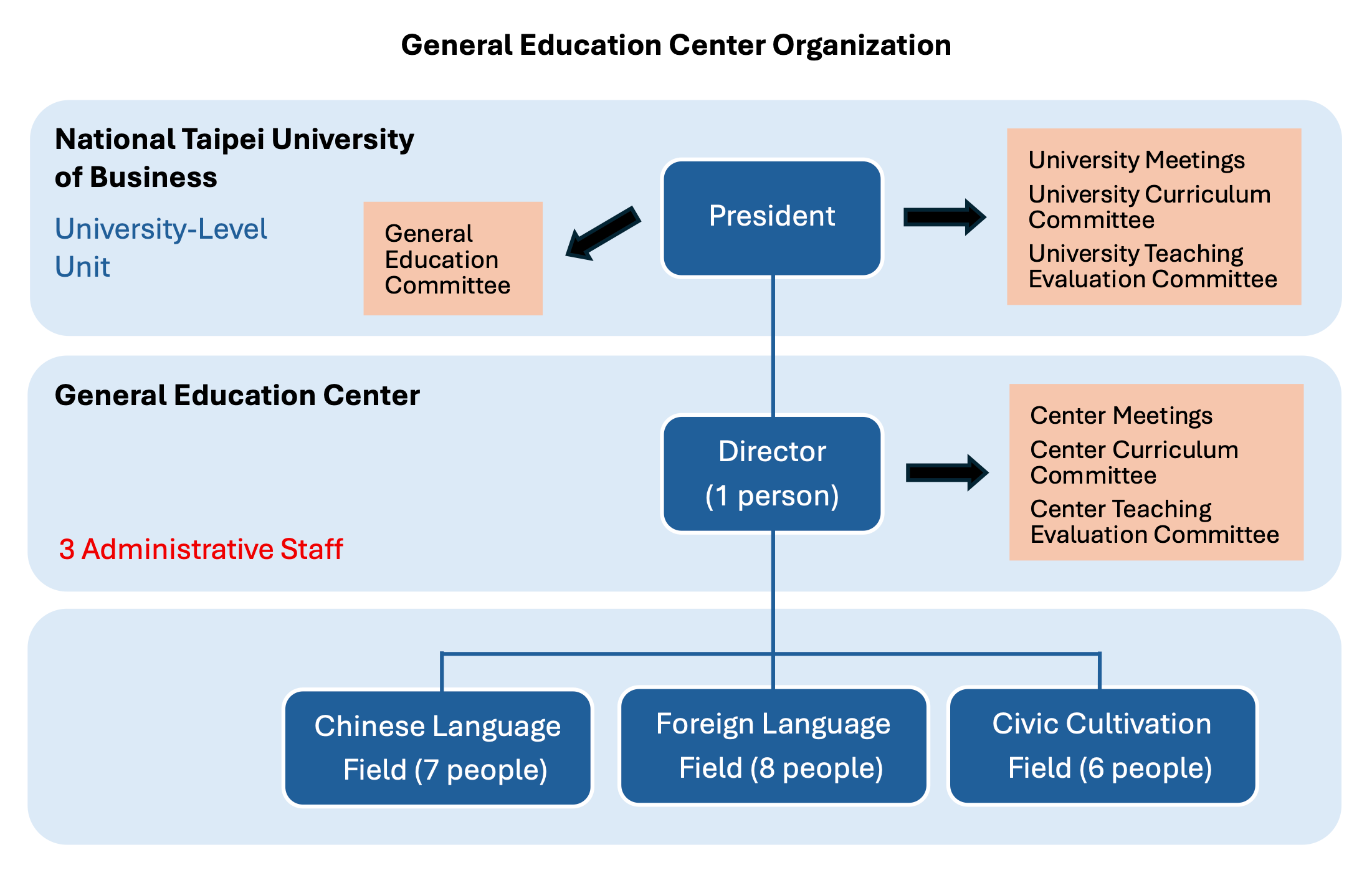
Diagram: Current Organizational Chart of the General Education Center
Note:
- The General Education Center at our university is a first-level teaching unit, equivalent in organizational level to each school. It is staffed by one Director and three Administrative Staff members. It is structured with three primary fields: Chinese Language, Foreign Languages and Civic Cultivation. The Center also has a Center Meeting, a Center Curriculum Committee, and a Center Teaching Evaluation Committee. In December 2015, the General Education Committee was established with the President as the convener.
- Each field has one convener, elected by the teachers within the field, who is responsible for coordinating teaching-related matters within that field.
The highest decision-making body within the center is the Center Meeting, and based on task nature or function, the following committees are established: Center Faculty Review Committee, Center Curriculum Committee, and General Education Committee (explained in the following table). Through various specialized committees, the General Education Center ensures the quality and effectiveness of its implementation outcomes. In addition, for matters not fully covered by the aforementioned committees, the Center has established specific guidelines, such as: NTUB Guidelines for Waiving Credits for General English Courses, NTUB Guidelines for Tiered Instruction of English Courses in the Four-Year Day Division, and NTUB General Education Center Course Selection Notes for Students. These regulations help facilitate the smooth execution of the Center’s overall operations and provide clear, actionable policies.
| Committee | Function and Responsibilities |
| Center Faculty Review Committee | Reviews faculty appointments, review, promotions, academic publications, research inventions, domestic and international training, sabbatical research, major awards and service extensions. |
| Center Curriculum Committee | Plans core and specialized courses within the center (including the design of general education course structures) and related drafts. |
| General Education Committee (Established in December 2015) |
Chaired by the president, this committee integrates issues related to general education courses across departments and offers advice on course development. |
The center fosters students' foundational knowledge through language and reasoning, civic cultivation, and diverse elective courses. Teaching methods are innovative and use diverse assessments to achieve the educational goal of well-rounded general education. Additionally, in collaboration with various colleges, the center plans mandatory interdisciplinary general education courses for students in different fields. The aim is to strengthen moral character, enhance cultural understanding, encourage social participation, and promote environmental conservation, all of which contribute to students’ soft skills, enhancing their employability and deepening their humanistic literacy.